
When we feel tight, our immediate instinct is often to try to stretch everything as far as it will go. But in reality, from a clinical osteopathic perspective, not all joint stiffness is created equal. Your body creates stiffness for completely different biomechanical and physiological reasons:
- Bad (Disuse) Stiffness: When joints built for dynamic movement get locked up from rigid shoes or long sitting, forcing adjacent joints up the chain to absorb landing shock.
- Protective (Guarding) Stiffness: When your nervous system intentionally tightens muscles like an internal brace to protect an unstable joint or lax ligaments (very common in hypermobility or during pregnancy as relaxin softens joint capsules).
- Post-Exercise Remodeling Stiffness: The temporary tightness that occurs 24–48 hours after a workout or heavy run, as your tendons and muscles rehydrate their matrix and repair micro-structural shifts.
- Structural (Arthritic) Stiffness: The natural morning “gelation” that occurs as cartilage thins and joint surfaces require gentle movement to pump in fresh fluid.
In this comprehensive guide, I will decode these four distinct types of stiffness, explain how your ankle joints directly dictate the health of your lower back, and share practical clinical tools to keep your frame moving comfortably for life.
Part 1: Bad Stiffness at the Foundation (Why Your Lower Back Cares About Your Ankles)
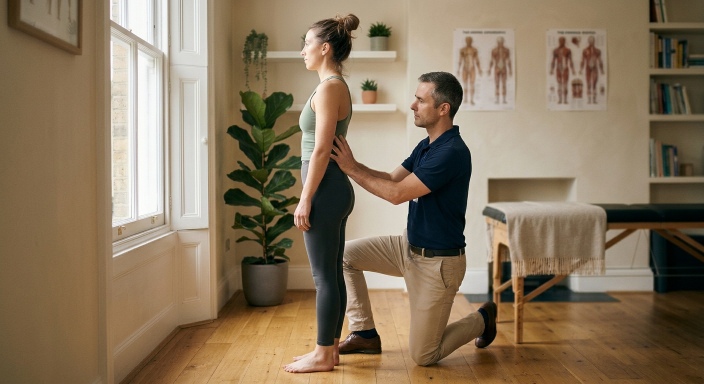
To understand why your spine cares about your feet, I look at the Kinetic Chain, the biomechanical reality that every joint in your lower body directly dictates how forces are absorbed higher up.
Each human foot contains 26 bones and 33 individual joints. It is naturally designed to act as a dynamic, springy shock absorber that flexes over uneven ground and sends continuous balance signals to your brain.
However, after spending decades inside rigid, narrow, or cushioned shoes, those 33 small foot joints gradually lose their independent movement. The foot stops behaving like a flexible spring and begins operating like a solid, rigid block.
What Happens Up the Chain?
When your foot loses its mobility and your ankle joint tightens:
- Your arch flattens: To compensate for a stiff ankle when walking or running, your body flattens your arch inward (over-pronation).
- Your leg twists: That inward collapse forces your shin and thigh bones to rotate inward, placing a sharp, twisting force straight through your kneecap.
- Your lower back takes the impact: Your pelvis tilts forward, forcing your lower back muscles (eg quadratus lumborum) to contract constantly just to keep you upright.
In short: stiff ankles force your knees, hips, and lower back to absorb landing forces they were never designed to handle. If you run, play court sports, or train at the gym, this loss of ankle mobility is often the hidden culprit behind stubborn runner’s knee, shin splints, or lower back aching after a session.
The 60-Second Foot & Ankle Mobiliser
To wake up the sensory receptors under your feet and take immediate mechanical pressure off your knees and back, try this quick drill while making your morning tea or coffee:
- The Tennis Ball Arch Roll: Stand barefoot (or in socks) near a counter for balance. Place a soft tennis ball or massage ball under the arch of your foot.
- Roll slowly: Apply comfortable downward pressure and slowly roll the ball from your heel to the base of your toes for 30 seconds per foot.
- Release the fascia: Pausing over tight spots releases the thick plantar tissue, allowing the 33 joints in your foot to spread and absorb impact naturally.
Restoring simple movement to your foundation makes walking, climbing stairs, and standing far easier on your upper joints.
Part 2: Protective, Hypermobile & Post-Workout Stiffness
When an area of your body feels tight, your immediate instinct might be to pull it into a deep, static stretch. But from an osteopathic perspective, aggressively stretching a muscle that is acting as a protective shield can actually increase your pain.
Protective Stiffness: The Body’s Internal Brace
If a ligament is naturally lax (as seen in joint hypermobility spectrums) or temporarily softened by hormones (like relaxin during pregnancy and nursing), your joint sockets lose some of their passive structural support.
To keep your pelvis, spine, or shoulders stable, your brain steps in. It reflexively dials up tone in the surrounding muscles, creating an internal “muscular splint” to prevent joint shearing.
- The Hypermobility Trap: People with hypermobile joints often feel perpetually tight in their hamstrings, neck, or lower back. They spend years trying to stretch those muscles out. But because the tightness is a protective reflex, stretching it away leaves the joint vulnerable, causing the brain to clamp down even tighter an hour later.
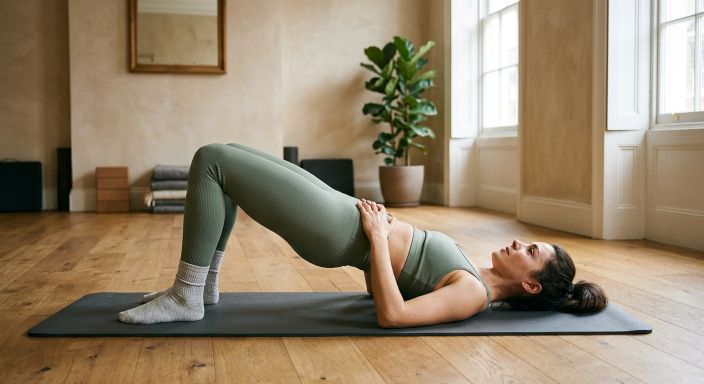
- What it needs: Isometric Stability. Giving the joint active muscular support through steady, stationary holds (like glute bridges, wall sits, or press-up holds) signals safety to your nervous system, allowing it to naturally relax the protective tension.
Part 3: Post-Exercise Remodelling Stiffness: The Metabolic Fluid Shift

If you wake up 24 to 48 hours after a hard run, tennis match, or gym session feeling like your legs are made of wood, you are experiencing Post-Exercise Remodelling Stiffness.
When you load a muscle or tendon eccentrically, like lowering a weight or landing from a running stride, two things happen:
- Fluid displacement: Repetitive mechanical compression temporarily squeezes bound water out of your tendons and fascial matrices (much like wringing out a sponge).
- Micro-repair signalling: Your body releases localized, low-grade inflammatory markers to repair micro-structural shifts in the muscle fibres, making the tissue temporarily tender and taut.
- The Golden Rule: Post-exercise stiffness should be broad, bilateral, and peak within 48 hours. It is a sign of tissue remodelling, not damage.
- What it needs: Parasympathetic Down-Regulation & Light Circulation. Fast-track fluid return with 5 physiological sighs (double inhale through the nose, long slow exhale through pursed lips), gentle walking, and electrolyte hydration. Avoid heavy stretching on sore, recovering muscle fibres.
Part 4: Tendon Compliance After 50
 As we get older, our tendons naturally lose some water content and become stiffer. While “stiff” sounds like a drawback, a moderately stiff tendon acts like a high-tension steel cable, it absorbs heavy landing forces quickly so your cartilage doesn’t have to. Targeted, heavy isometric or compound loading builds healthy tendon density, whereas aggressively stretching cold tendons can destabilize aging joint sockets.
The Stiffness Decoder (Arthritis vs. Guarding)
To help you decide whether your body is asking for movement, stability, or recovery, use this clinical framework to decode your morning aches:
| Stiffness Type | Primary Cause | Clinical Clue / Signature | What Your Body Needs |
| 1. Disuse / Mechanical | Locked joints in feet/ankles from footwear or desk sitting. | Tightness that is instantly relieved by moving through full joint ranges. | Joint Mobilization: Foot/ankle rolls, dynamic mobility drills. |
| 2. Protective / Guarding | Brain locking muscles to shield hypermobile or lax joints. | Deep, braced feeling that worsens or rebounds if forcibly stretched. | Isometric Stability: Wall sits, glute bridges, core activations. |
| 3. Post-Exercise Remodelling | Micro-repair and temporary matrix fluid displacement. | Symmetrical muscle soreness peaking 24–48 hours post-workout. | Active Recovery: Light walking, vagal breathwork, hydration. |
| 4. Structural / Arthritic | Thinned cartilage and thickened overnight synovial fluid. | Classic “gelation”—sharp at first, but eases within 15–30 minutes. | Continuous Motion: Gentle walking, cycling, or aquatic exercises. |
The 30-Minute Arthritic Test
Arthritic stiffness follows a classic “gelation” pattern. When you first stand up after sleeping or sitting for an hour, articular cartilage has less synovial fluid coating its surface. However, as you gently take steps, your joint acts like a mechanical pump, circulating fluid and easing the discomfort within 15 to 30 minutes. If your stiffness improves as you move, your joints thrive on low-impact, repetitive motion.
The Golden Rules of Joint Longevity
- If your stiffness loosens with light movement, your frame is asking for motion.
- If your stiffness gets tighter or sharper the more you push it, your frame is asking for stability and alignment.
- If your stiffness peaks two days after a workout, your frame is asking for recovery and hydration.
Navigating joint health isn’t about ignoring discomfort or forcing cold joints into deep stretches. It’s about reading your body’s signals accurately so you can give it exactly what it needs.
How I Can Help
If you are dealing with persistent stiffness and aren’t sure whether your joints need mobilization, stabilization, or targeted hands-on care, I can evaluate your alignment from the ground up.
At Hampstead Osteopathy, I locate mechanical restrictions along the kinetic chain to take unnecessary strain off your joints so you can move with complete confidence.
👉 Book a Clinical Assessment Online to find a consultation time that suits you.
